


Top Trending Government News News & Highlights


AAP must leave its headquarters by June 15th, per a Supreme Court order.
The Aam Aadmi Party of Arvind Kejriwal will have to leave its headquarters, which are located on a plot of land designated for the High Court. The good news is that you still have until June 15 to act. The Supreme Court gave the party a long deadline because of the upcoming Lok Sabha elections, emphasizing that this is an encroachment case. The party may now submit an application for alternative land to the Land and Development Office of the Center.The bench, which included Chief Justice D Y Chandrachud and Justices J B Pardiwala and Manoj Misra, stated, "We would request the L&DO to process the application and communicate its decision within a period of four weeks." The bench continued, "AAP has no legal right to remain on the land." The Delhi High Court was granted land in February to expand its operations and build more courtrooms for the Rouse Avenue location. The court had noticed that the AAP was intruding on this land. When considering a case involving the nation's judicial system, the highest court took notice of the issue.The state government promised at a meeting on February 15 that the plot would be removed in two months if a substitute plot was provided, in response to a court order. However, the situation remained unchanged. According to India's Chief Justice, DY Chandrachud, nobody has the authority to impose law on others. "It is absurd for any political party to sit on it. Every intrusion will be eliminated... The land should be given to the High Court so that it can be utilized by the general public and citizens, Justice Chandrachud stated.
Published 04 Mar 2024 05:31 PM

Article 21: The Constitutions Soul, with Citizens Liberty Supreme
According to the Supreme Court, Article 21 is the essence of the Constitution because it protects citizens' rights to liberty, which are so valuable that a person would lose them if the high court takes too long to decide cases pertaining to it. Amol Vithal Vahile, a prime accused in the murder of a corporator in Maharashtra, was granted bail by the Bombay High Court on January 29 following prodding from the top court, according to a bench of Justices B R Gavai and Sandeep Mehta.In a recent ruling, the bench stated that it is evident that prior to this court's order being issued on January 29, 2024, the high court had dismissed the bail application on one or more grounds rather than considering it on its merits.It goes without saying that Article 21 of the Indian Constitution is its core because it upholds the fundamental right to liberty for all citizens. It stated, "Depriving the party of their precious right guaranteed under Article 21 of the Constitution of India would mean not reaching a quick decision and brushing off the issue on one or the other basis pertaining to a citizen's liberty." The bench stated that it has encountered numerous cases from the Bombay High Court in which the applications for bail and anticipatory bail were not resolved promptly. The bench mentioned one instance where the application for anticipatory bail was pending for over four years. "We have also encountered many cases where the judges find an excuse to reroute the case on unrelated grounds rather than rendering a decision based on the merits of the case. As a result, we ask the chief justice of the Bombay High Court to communicate our request to all judges who have criminal jurisdiction so that the issue of bail and anticipatory bail can be decided as soon as possible," the bench stated.It requested that the Supreme Court's Registrar (Judicial) forward this directive to the High Court's Registrar (Judicial), who will present it to the Bombay High Court's chief justice. The bench stated on January 29 that, despite the fact that Vahile had been detained for more than seven years, on March 30, 2023, the high court had ordered him to appear before the trial court for regular bail.
Published 02 Mar 2024 06:02 PM

India Receives Its Second Space Port, Excitement for Rocket Startups
Today, Prime Minister Narendra Modi will lay the foundation stone for India's second launch site, Kulasekharapatnam, which is situated in the Thoothukudi district of Tamil Nadu. This will significantly advance the nation's spacefaring endeavors. The new launch pad has the small rocket community in India, including ISRO and startups, giddy with anticipation for more efficient small rocket launches.Up until now, all rockets used to launch satellites into orbit were launched from the nation's single spaceport, which was located in Sriharikota, Andhra Pradesh. To date, India has launched 95 rockets from Sriharikota, 80 of which have been declared successful. Renamed the Satish Dhawan Space Center, it began modestly in 1971 with the launch of a sounding rocket, the RH-125. The center is currently getting ready for India's human spaceflight project, Gaganyaan, to launch. Satish Dhawan Space Center has a distinct advantage—it is one of the world's southernmost rocket ports—but it also has a major disadvantage. The land mass of Sri Lanka presents a safety concern for rockets launching in polar or southerly directions because it keeps rocket debris from landing on foreign soil.In order to lessen this, ISRO has traditionally carried out a unique manoeuvre referred to as the "dogleg maneuver" in order to avoid Sri Lanka when conducting direct southward launches. Although there is a penalty for this maneuver, it can be tolerated for larger rockets with sufficient fuel, such as PSLV, GSLV, and LVM-3. But the advantages of using Sriharikota as the preferred launch site become clear as India gains proficiency in the launch of smaller rockets, such as the Small Satellite Launch Vehicle (SSLV), which can carry satellites weighing up to 500 kilograms. According to an ISRO rocket specialist, it becomes almost impossible to launch small rockets from Sriharikota in polar or southern trajectories with payloads weighing between 500 and 700 kg. As a result, Kulasekharapatnam has been chosen as the second launch site to address these issues because of its expanding small rocket market.
Published 28 Feb 2024 05:29 PM

Survey Says RBIs Paytm Action Won Affect Merchants Trust
Merchants' trust in the payment platform is unaffected by the severe limitations the Reserve Bank of India (RBI) placed on Paytm Payments Bank (PPBL), according to a survey done. According to Datum Intelligence, a Gurugram-based provider of business consulting and services, 59% of retailers still use Paytm and don't think the government crackdown will have an immediate effect on their business. The business conducted a survey with 2,000 business owners in 12 cities who accept payments through Paytm apps. According to a press release from Datum Intelligence, it was done between February 7 and February 15. Survey Says RBI's Paytm Action Won't Affect Merchants' Trust According to a Datum survey, 76% of retailers accept payments through Paytm. Merchants' trust in the payment platform is unaffected by the severe limitations the Reserve Bank of India (RBI) placed on Paytm Payments Bank (PPBL), according to a survey done. According to Datum Intelligence, a Gurugram-based provider of business consulting and services, 59% of retailers still use Paytm and don't think the government crackdown will have an immediate effect on their business. The business conducted a survey with 2,000 business owners in 12 cities who accept payments through Paytm apps. According to a press release from Datum Intelligence, it was done between February 7 and February 15. According to the survey, 21% of retailers are awaiting additional information The fact that a Paytm representative contacted them following the RBI ruling is what gives retailers their confidence. "After being contacted by a Paytm representative, 71% of merchants feel comfortable continuing to use Paytm for payments. According to the Datum Intelligence survey, only 11% of respondents are less confident about using Paytm for payments, and 14% of respondents are still looking for more information."Overall, the impact is limited on the merchant business and Paytm is engaging with merchants to reduce the damage and merchants are also waiting before deciding on alternatives," it added.
Published 28 Feb 2024 05:01 PM


Government News
Government News & Trends where we share you the latest updates under the government authorities globally starting from India to USA, China, Russia, Pakistan, UK and many more nations.

JN shouldn't cause you to panic.One COVID-19 variation is Health Minister
"In response to the introduction of the new COVID-19 variant JN.1, Health Minister Saurabh Bharadwaj urged Delhi residents on Wednesday to ""not panic."" He explained that although the strain is contagious, it is mild, with only a small number of patients requiring oxygen support. ""Take precautions, but don't panic—this [new variant] is not very dangerous. About 90% of patients are recovering while receiving treatment at home, Mr. Bharadwaj informed the media, noting that comorbidity patients were the focus of reports of deaths in other States."

For FY23, Unacademys revenue jumps 26% to Rs 907 crore while its loss cuts
The test-prep startup Unacademy reported that, despite constant layoffs at the company, its losses in FY23 decreased by 41% to Rs 1,678 crore. In FY23, employee-related expenses decreased by 28% to Rs 1,281 crore.The test-prep startup Unacademy reported that, despite constant layoffs at the company, its losses in FY23 decreased by 41% to Rs 1,678 crore. In FY23, employee-related expenses decreased by 28% to Rs 1,281 crore.In what was a difficult year for the startup environment, many modern businesses, like Myntra, ZestMoney, and Curefoods, reported stronger revenues for FY23, but their losses also increased.Revenue at Myntra rises to Rs 4,375 crore: The apparel retailer Myntra, which is owned by Flipkart, reported a 25% increase in operating revenue to Rs 4,375 crore in FY23, despite a 31% increase in losses to Rs 782 crore. The online fashion platform's largest expense, amounting to Rs 1,758 crore, was spent on advertising and promotional activities, representing a 35% increase over the previous year.Unacademy reduces losses to Rs 1,678 crore, or 41%: Unacademy, a startup providing test preparation, reported that its losses in FY23, which included several layoffs at the company, decreased by 41% to Rs 1,678 crore. The Bengaluru-based firm saw a 26% increase in sales to Rs 907 crore during the year, while costs associated with payroll decreased by 28% to Rs 1,281 crore.ZestMoney reports a loss of Rs 412 crore. ZestMoney, a troubled startup that has been searching for a buyer, declared a net loss of Rs 412.4 crore for the fiscal year 2023. On the other hand, while total expenses increased by 21% to Rs 662.2 crore, overall revenue for the buy-now-pay-later platform increased by 72% to Rs 250 crore.
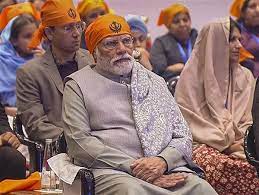
Prime Minister Modi on Veer Bal Diwas: Sikh gurus taught Indians
Speaking on Tuesday, Prime Minister Narendra Modi said that Sikh gurus had inspired Indians to improve and develop their nation by teaching them to live for the beauty of their homeland. He was giving a speech at a ceremony called "Veer Bal Diwas" to honor the martyrdom of Guru Gobind Singh's two sons. According to PM Modi, their sacrifices are being honored not only in India but also around the world through initiatives in nations like Australia and the United States. We don't need to squander time or pause for a single moment. These lessons came from the gurus...We must live for the honor and glory of our nation. We must live for the benefit of the nation, PM Modi stated.
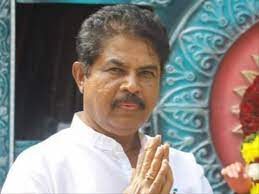
Karnataka LoP Arrested For Opposing Karsevak Shrikant Pujaris Arrest Regarding Babri Demolition
Legislative Assembly member and BJP leader R Ashoka was held by Karnataka police for allegedly inciting rioting following the 1992 demolition of the Babri Masjid. Ashoka had staged a demonstration against the state government over the detention of Shrikant Pujari. The BJP workers who have been protesting the arrest escalated their demonstration on Thursday by starting the 'I'm also a Karsevak, Arrest Me Too' campaign.LoP Karnataka Legislative Assembly & BJP politician R Ashoka was taken into custody by the police, according to ANI. Along with party members, he was demonstrating against the state government over the detention of Shrikant Pujari, who was taken into custody for his alleged role in the rioting that followed the 1992 demolition of the Babri Masjid.LoP Karnataka Legislative Assembly & BJP politician R Ashoka was taken into custody by the police, according to ANI. Along with party members, he was demonstrating against the state government over the detention of Shrikant Pujari, who was taken into custody for his alleged role in the rioting that followed the 1992 demolition of the Babri Masjid.

2023s Military Innovations and What Defense Technology Can Expect in 2024
Amidst escalating geopolitical tensions worldwide, several nations, such as Russia and India, spearheaded military innovation in 2023. Sputnik India takes a look back at some of the most inventive weapons from the previous year. In 2023, a number of cutting-edge weapon systems made their debuts. Russia, in particular, used its most advanced defense hardware in Ukraine, where the Eurasian sovereign state was engaged in a special military operation against the forces of Volodymyr Zelensky, the leader of that country.India, a longstanding strategic ally of Moscow, was not going to lag behind in terms of military hardware as New Delhi expanded its stockpile in response to the Indo-Pacific region becoming as the center of attention for world geopolitics. It's interesting to note that in 2023, Indian armaments and ammunition production and exports reached a record high.India's Defence Ministry (MoD) reports that during the current fiscal year, the South Asian nation exported military equipment valued at INR 16,000 crore ($1.95 billion). The figures indicate a $360 million increase in exports compared to the previous fiscal year.Additionally, BJP officials informed the media that it is unlikely for the panel to accept requests from rival parties' defectors that they be appointed to prestigious posts in exchange for their allegations. Senior members of the saffron party gathered in New Delhi to plan for the impending parliamentary elections and the dedication of the Ram Temple in the Uttar Pradesh city of Ayodhya. These members included Federal Ministers Bhupendra Yadav, Ashwini Vaishnav, Chief Himanta Biswa Sarma of the Assam State, and general secretaries Tarun Chugh and Sunil Bansal.
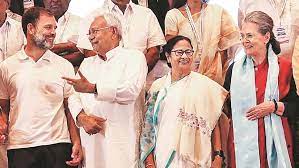
A New Panel Is Formated by the BJP to Examine New Hires Before the 2024 Elections
With the new panel, the federally dominant BJP hopes to assess potential members' devotion in advance of the 2024 parliamentary elections. A new panel has been established by the Bharatiya Janata Party (BJP) to screen lawmakers from other parties who may want to join the party before the March–April 2024 general elections.The panel will determine whether to accept or reject the politicians who wish to join the party, according to media reports citing party sources. The BJP seeks to reduce the possibility of enlisting supporters who might turn against them if they are elected to the legislature. Only after receiving consent from the committee will anyone wishing to cross the floor be permitted to participate. It is anticipated that the committee will convene for the first time on January 6.

President Muizzu of the Maldives arrives in China for a closely monitored state visit
The visit to China by Maldivian President Mohamed Muizzu takes place against the backdrop of a diplomatic spat between India and the Maldives following remarks made disparagingly about Prime Minister Narendra Modi. At the invitation of Chinese President Xi Jinping, Maldivian President Mohamed Muizzu landed in China on Monday and will stay for five days till January 12, according to an official announcement.During his visit, Muizzu is also expected to meet with business executives and senior Chinese government officials at the "Invest Maldives Forum," according to the presidency. China is currently the Maldives' biggest creditor; Male owes Beijing around $1.3 billion in debt obligations. Beijing is among the nation's largest investors and economic partners; in 2017, the two governments signed a Free Trade Agreement (FTA). The Maldives has also ratified the Belt and Road Initiative (BRI), which is supported by Beijing.
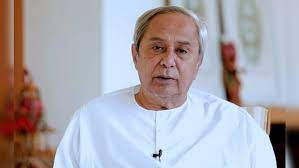
Odisha is investing more than Rs 2,500 crore to help millet farmers with their income and way of life.
"On Thursday, Odisha Chief Minister Naveen Patnaik announced that his government is investing more than Rs 2,500 crore to help the state's millet farmers with income and livelihood support. The Odisha Millets Mission was recently started by the state government in 2017 with the goal of restoring the cereal's ecosystem.Odisha has been the ""pioneer in designing a people-centric Millet Mission with focus on livelihood and nutrition of tribal communities"" , according to him. According to Patnaik, ""My government will make every effort to turn Odisha into a millet center of excellence and contribute to economic growth, wellbeing, and health of the people of Odisha."" He emphasized that Odisha is the first state to organize an international convention involving all the stakeholders, noting that the UN has declared 2023 to be the International Year of Millets. In the millet value chain, the chief minister commended the work of the Mission Shakti Women Self Help Groups (SHGs). These Self-Help Groups, operating under the name Millet Shakti, have demonstrated to the world the significant role that millet-based businesses can play in enhancing livelihoods. "
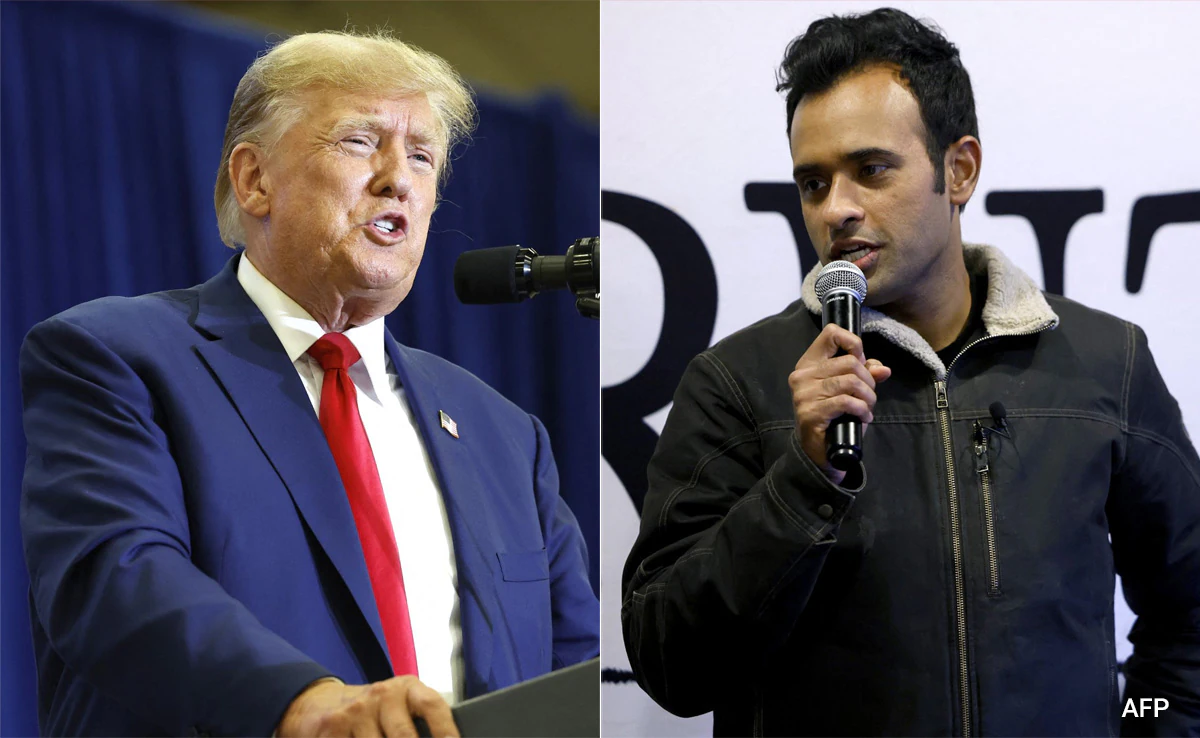
V Ramaswamy Resigns from the Presidential Race and Backs Trump Following Victory in the Iowa Caucuses
Entrepreneur Vivek Ramaswamy, who is Indian-American, withdrew from the 2024 US presidential contest today and declared his endorsement of Donald Trump following a lackluster showing in the Iowa Republican primary. Despite being relatively unknown in political circles when he entered the race in February 2023, Mr. Ramaswamy was able to attract the attention and support of Republican voters by emphasizing America first and holding strong views on immigration. His campaign strategy, in terms of both tone and policy, was very similar to that of the former president Trump. Mr. Ramaswamy aimed to reach out to the conservative support base that had helped Trump win earlier elections.Trump's victory in Iowa that same evening cemented his standing as the front-runner for the Republican nomination.Born in Ohio to Keralan immigrants, Mr. Ramaswamy became one of the surprise candidates in a Republican field still heavily influenced by Trump's name. But in the final days before the Iowa caucuses, Mr. Ramaswamy found himself under fire from Trump, who publicly attacked him, calling him a "fraud" on his social media platform Truth Social and saying that supporting the Indian-American represented siding with the "other side."


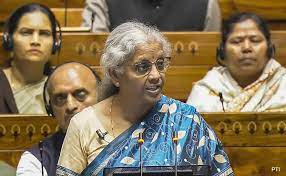
The last budget before the polls had the slogan "Developed India By 2047" and no tax changes.
Delhi, New: Union Finance Minister Nirmala Sitharaman stated on Thursday morning during the reading of a statement of the nation's finances in a special session of Parliament that there will be no changes to the income tax slabs, which have been lowered and rationalized, in the 2024 interim Budget. "I propose to retain the same tax rates for direct and indirect taxes, including import duties," said Ms. Sitharaman. Nonetheless, she suggested that unpaid direct tax demands of up to ₹ 25,000 until FY09/10 and up to ₹ 10,000 for FY10/11 to FY14/15 be withdrawn, claiming that this would help approximately one crore taxpayers. Ms. Sitharaman commented, "... there are a lot of small-scale, unverified, unreconciled, or contested direct tax demands, many of which date back to 1962, which are still on the books, worrying honest taxpayers... I would like to remove these unfulfilled direct tax demands."Regarding the overall tax situation, the Finance Minister reported that over the previous ten years, direct collections had more than tripled and that the number of individuals filing returns had increased by 2.4 times. Given that this is an interim budget, intended primarily to fund government operations until a new administration is elected and assumes power later this year, the suspension of tax slab revisions was not surprising.
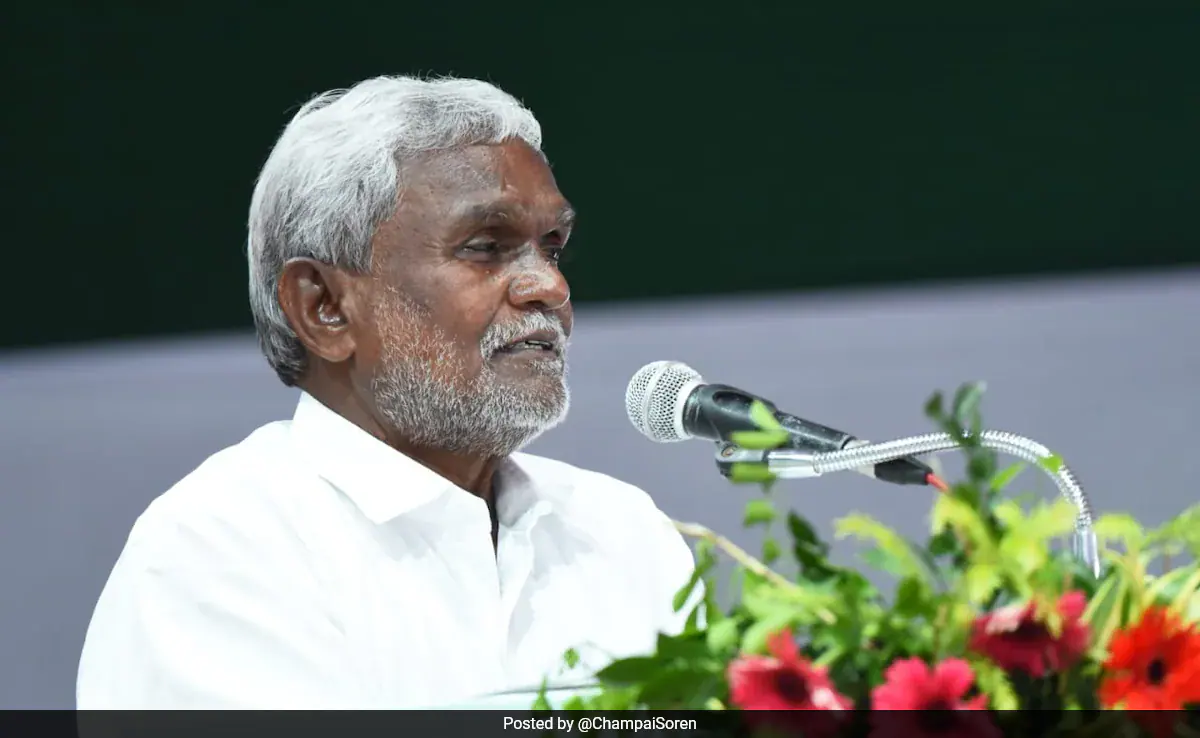
Champai Soren meets with the governor, saying, "No Government In Jharkhand For 18 Hours"
"There is no government in Jharkhand for 18 hours now and a situation of confusion has emerged, Chief Minister-in-waiting Champai Soren has told Governor CP Radhakrishnan, urging him to take immediate steps for government formation. Along with five other MLAs from the JMM, Congress, and RJD alliance, Mr. Soren met with the governor this evening. Mr Soren was yesterday chosen the legislative party leader of Jharkhand Mukti Morcha (JMM) after Hemant Soren stepped down as the Chief Minister and was arrested by the Enforcement Directorate in a corruption case.Champai Soren wrote to the Governor stating that he had sent a letter of support, signed by 47 MLAs from JMM, Congress, and RJD, to the Governor yesterday. This number is greater than the majority of the 81-member Assembly. The MLAs had accompanied him to the Raj Bhavan, he continued, but they were not permitted inside.""Sir, the state has been without a government for the past eighteen hours. There is a state of uncertainty. As the head of state constitutionally, we, the MLAs, and the people of the state expect you to take prompt action to clear the air and establish a popular government to bring the state out of disarray ""in Hindi, he wrote. order to reassure the governor that he has the support of the majority, Champai Soren continued, he could bring all of the MLAs who are in his corner to his home. Hemant Soren is under investigation in relation to a rumored mafia scheme in Jharkhand involving the unlawful transfer of land ownership. "
The government names one part-time and three full-time members for the 16th Finance Commission.
Soumya Kanti Ghosh, the group chief economic advisor of State Bank of India (SBI), has been selected as a part-time member.New Delhi: The finance ministry announced in a statement on Wednesday that the government has appointed three full-time and one part-time member to the Sixteenth Finance Commission (16th FC).According to the statement, the commission's full-time members are Niranjan Rajadhyaksha, executive director of Artha Global, former special secretary for expenditures and member of the 15th Finance Commission Ajay Narayan Jha.It further stated that Soumya Kanti Ghosh, the group chief economic advisor for State Bank of India (SBI), has been selected as a part-time member.According to the announcement, "it has been requested that the Sixteenth Finance Commission make its recommendations available by October 31, 2025, covering an award period of 5 years commencing 1st April, 2026."In order to propose a devolution formula for tax income between the Center and states, the government last month named Arvind Panagariya, a professor at Columbia University and former vice-chairman of NITI Aayog, as the 16th chairman of the Federal Communications Commission (FC).The government announced the terms of reference (ToR) for the 16th commission on November 29. In addition to reviewing the current arrangements for financing disaster management initiatives, the ToR asked the body to recommend ways to augment state resources for local bodies. Panagariya's appointment order was issued approximately one month later. Ritvik R. Pandey, a joint secretary in the Department of Revenue and an AS officer from the 1998 batch, was assigned as an officer on special duty for the 16th Finance Commission's advance cell on November 6th, with the rank and compensation of an extra secretary."The allocation between the States of the respective shares of such proceeds and the distribution between the Union and the States of the net proceeds of taxes which are to be, or may be, divided between them under Chapter I, Part XII of the Constitution," stated the original set of rules for the commission.The second ToR states, "The principles which should govern the grants-in-aid of the revenues of the States out of the Consolidated Fund of India and the sums to be paid to the States by way of grants-in-aid of their revenues under article 275 of the Constitution for the purposes other than those specified in the provisos to clause (1) of that article."The third treaty on resources (ToR) deals with the actions required to increase a state's consolidated fund in order to augment the resources of municipalities and panchayats, based on the recommendations of the corresponding state finance commissions.According to the statement, the 16th FC may examine current arrangements for funding disaster management activities while taking into account the funds established under the Disaster Management Act and offer pertinent recommendations.
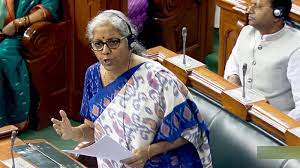
Budget 2024 For a few hours of Budget presentation, preparations start 6 months in advance know why
Union Budget 2024: On Thursday, February 1, 2024, Finance Minister Nirmala Sitharaman is scheduled to deliver the Interim Budget 2024. Every budget includes some items that address the needs of various government agencies, states, union territories, and citizens from all walks of life in India. For those in business and the salaried class, it is one of the most anticipated occasions of the year. During their potentially multi-hour speech, the finance minister makes several significant announcements. But it takes six months to develop the budget that is presented in a few hours. Are you aware of the reason? Be aware of thisInterim Budget 2024: What can we expect when Finance Minister Nirmala Sitharaman presents the Interim Budget 2024 on February 1, 2024? A member of the salaried class for tax breaks; an entrepreneur for programs that support entrepreneurs; an experienced businessman for regulations that can protect their company or boost their earnings.For this reason, most Indians pay attention to the significant statements made by the finance minister during their annual speech. These announcements contained in the budget speech could be made in a few minutes or several hours. However, the preparation time for a speech that lasts only a few hours is about six months.Interim Budget 2024: On February 1 at 11 a.m., Union Finance Minister Nirmala Sitharaman is scheduled to read the Interim Budget 2024 in the Parliament. The Interim Budget, which will implement the major decisions taken by the Center, is the focus of attention. Prior to the Lok Sabha elections, the departing government presents the interim budget during the budget session. After winning the Lok Sabha elections, the newly formed government then presents the comprehensive budget.In addition to discussing the government's accomplishments since 2014, FM Sitharaman's Interim Budget is anticipated to look ahead to Amrit Kaal in 2047. Similar to the previous interim budget, the Budget 2024 paper is anticipated to provide historical context, assess the current situation, and outline plans for the future. A summary of the government's anticipated revenue and outlays through the formation of the next government is the primary purpose of the interim budget. A comprehensive budget, on the other hand, addresses every facet of government funding, including receipts and outlays as well as allocations and policy declarations. A full-year budget outlines the nation's economic course for the whole fiscal year and acts as a strategic plan. The financial data for the transitional phase is provided by the interim budget.The timeline for presenting an interim budget is identical to that of the Union budget during a regular fiscal year. The Interim Budget has grown in importance for the ruling administrations in recent years as a tactical instrument for national elections. It enables them to outline the ruling party's economic strategy and provide justification for reelection.Some significant modifications were announced by former FM Piyush Goyal in the most recent interim budget: > Earnings up to Rs 5 lakh are exempt from income tax; individuals with gross incomes up to Rs 6.5 lakh are exempt from paying taxes if they invest in authorized stocks and provident funds. The TDS level on interest on bank and post office deposits was raised from Rs 10,000 to Rs 40,000. The TDS barrier on rental income was increased from Rs 1.8 lakh to Rs 2.4 lakh. The standard tax deduction for salaried individuals was raised from Rs 40,000 to Rs 50,000. I-T will process returns in a day.> In the following two years, all tax return verification will be completed electronically without involving the taxpayer. a bundle of Rs.The 74-page report, "The Indian Economy: A Review," authored by Chief Economic Advisor V Anantha Nageswaran, was delivered by the NDA administration this year. It provided an assessment of India's economy and outlined difficulties for the upcoming fiscal year. "This is not the Department of Economic Affairs' Economic Survey of India. Following the general elections, it will take precedence over the entire budget. The paper titled "Indian Economy–A Review" stated, "This review offers a brief sketch of the outlook for the economy in the coming years and takes stock of the state of the Indian economy and its journey over the last ten years." Following the presentation of the Interim Budget, a vote-on-account is held by the Parliament. This clause enables the government to secure parliamentaryA complete budget and an interim budget are comparable. One significant distinction is that it covers forecasts for a shorter time frame instead of the whole fiscal year. Without requiring a formal discussion, Parliament can pass a vote-on-account that just addresses spending.
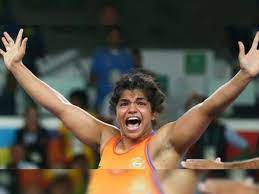
Sakshi Malik, a wrestler, claims that the chief of false titles is suspended. The ministry of sports issues a legal notice.
Malik appealed to the sports ministry about the situation, questioning how a federation member who was suspended could embezzle money from the WFI.Olympic wrestler Sakshi Malik accused the suspended chairman of the wrestling federation of India (WFI), Sanjay Singh, on Tuesday of organizing championships and giving phony certificates, a month after the Central government suspended the WFI panel.Malik appealed to the sports ministry about the situation, questioning how a federation member who was suspended could embezzle money from the WFI. She said that athletes would run into problems if they presented phony credentials."The National Wrestling Championship is being run by Sanjay Singh, an associate of Brij Bhushan, as per his wish and he is giving fake certificates to the players, which is illegal," Malik said in a post on X, the previous Twitter platform.She continued by saying that the Sports Ministry was planning to host the national wrestling championship in Jaipur and that Singh was staging a phony tournament in order to "assert his dominance.""To demonstrate his superiority in wrestling, Sanjay Singh is forging and distributing fake certificates of several national championships before of the Sports Ministry's scheduled wrestling national championship in Jaipur. How is it possible for an individual under suspension from the organization to embezzle its funds?Malik went on to say that these certificates can result in the players being punished. "Action will be taken against the poor players when they go tomorrow to ask for jobs with these certificates." However, the players are not at fault.She urged Anurag Thakur, the minister of sports, to investigate the matter. "Sanjay Singh should be held accountable right away for his fraudulent actions, as he continues to conduct fraudulent acts even after his activities have been prohibited. Malik stated, "I beg the Sports Minister, Shri Anurag Thakur ji, to look into this matter and prevent the players' futures from being spoiled."Malik included an image of the purportedly fraudulent credentials being given to athletes in the article. Sanjay Singh received a severe warning from the Sports Ministry about possible legal consequences. Singh recently made "baseless and mischievous" comments about the government's recognition of WFI, to which this is in reaction. The ministry made it clear that any competition run by the WFI would not be accepted as "sanctioned."According to PTI, Singh had previously declared that almost 700 wrestlers would compete in the Senior National Championship, which would take place in Pune from January 29 to January 31.The ministry wrote to Singh, stating, "Again, you are making completely baseless and mischievous claims regarding the recognition of the Executive Committee of the WFI that is currently under suspension and about the competitions that you are holding in Pune."
Nitishs Return to NDA: Its Wrong to Conclude a Cakewalk for the BJP in Bihar
“The BJP, of course, has got psychological advantage by bringing the Bihar CM and Janata Dal (United) president from the INDIA bloc, of which he was the architect. But there is a palpable anger among the people against Nitish. The BJP will have to pay the price for accepting him back to its fold,” the election strategist turned activist, Prashant Kishor said.Kishore predicted, “Irrespective of whatever alliance Nitish contests with, his party won’t be able to win more than 20 seats in the assembly polls.” Kishore, who is on his Jan Suraj padyatra in north Bihar’s Begusarai district these days, has been advancing this argument in his speeches as well as his interviews with the media. The widely held ‘assumption’ that the BJP’s victory is a “done deal” particularly after Nitish jumping to its side has subsumed the likely troubles that the Hindutva party might face in the run-up to the Lok Sabha elections, expected in April-May, this year.The first and foremost trouble which the BJP is all set to face is over sharing of seats. Nitish’s JDU and the Lok Janshakti Party (LJP) of Ram Vilas Paswan (alive then) were the part of the BJP led National Democratic Alliance (NDA) in 2019. The BJP and the JDU had shared 17 seats each, sparing six seats for the LJP. The NDA had won 39 seats—BJP-17, JDU-16 and LJP-6. Now, besides Nitish’s JDU, the BJP has Upendra Kushwaha’s Rashtriya Lok Samata Party (RLSP), Jitan Ram Manjhi’s Hindustani Aawam Morcha – Secular (HAMS), Chirag Paswan’s LJP and his uncle Pashupatinath Paras’s Rashtriya Lok Janshakti Party (RLJP) are in the NDA. Creating a buzz in the name of Ram temple and around Prime Minister Narendra Modi’s ‘persona’, the BJP cadres are clamouring for more seats than what they had contested in Bihar in 2019. The RLSP, the HAMS, the LJP and the RLJP, which have been with the BJP from before Nitish’s JDU has joined it, are, obviously, expecting their share of seats. There are only 40 seats in the state to share with. How many seats the BJP will keep in its share and how much will it spare for its five other partners? Needless to say that there is an apparent disquiet in the camps of these parties on Nitish’s return in the NDA; their lack of enthusiasm was obvious at Nitish’s ninth swearing-in as the CM at Patna’s Raj Bhavan on Saturday-January 28.
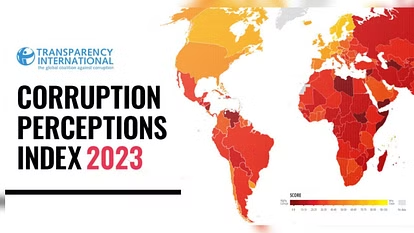
Global Corruption Index 2023: India Ranks 93rd Out of 180 Countries, Was 85th in 2022
The index comes at a time when the Union government run by the Bharatiya Janata Party is targeting only opposition leaders through its investigating agencies – ostensibly to weaken their public appeal before the crucial 2024 general elections and project the INDIA alliance as corrupt.Significantly, of India’s 28 states, BJP and its allies were in power in 17 in 2023. As per the country-wise corruption perception index (CPI) of the report put together by Transparency International (TI), a noted platform that works in over a hundred countries to fight corruption and promote transparency in public life, India has slipped from 85th position in 2022 to 93rd in 2023. In all, TI ranks 180 countries in terms of their perceived levels of public sector corruption in a scale of 0 to 100; the perceived levels are drawn from consultations with experts and people in business in the respective countries. Those closer to the scale of 100 are perceived to be highly corrupt. While India stands at 93, the country’s overall score for 2023 stands at 39, one point lower than 2022. About India, the TI report states, “India (39) shows score fluctuations small enough that no firm conclusions can be drawn on any significant change. However, ahead of the elections, India sees further narrowing of civic space, including through the passage of a bill that could be a ‘grave threat to fundamental rights’.”Among India’s neighbours, China is shown at a score of 42 (against India’s 39) but the report cautions that the country’s heavy reliance on punishment rather than institutional checks on power raises doubts over the long-term effectiveness” of its anti-corruption measures. China, which has been grabbing headlines for cracking down on corruption, has punished over 3.7 million public officials in the last 10 years.

Nasscom wants government to let overseas Indian startups list directly
India-focused startups incorporated overseas should be able to list on the domestic stock exchanges within the existing externalised structures, Indian industry body National Association of Software and Service Companies (Nasscom) has suggested as part of its Union Budget 2024-25 recommendations.Out of 139 startups who participated in a survey conducted by Nasscom, approximately 16.5% of Indian-origin startups have externalised legal structures and would consider raising equity capital through public listing in India if the regulations are amended to allow for a direct listing, it said.Out of 139 startups who participated in a survey conducted by Nasscom, approximately 16.5% of Indian-origin startups have externalised legal structures and would consider raising equity capital through public listing in India if the regulations are amended to allow for a direct listing, it said.India-focused startups incorporated overseas should be able to list on the domestic stock exchanges within the existing externalised structures, Indian industry body National Association of Software and Service Companies (Nasscom) has suggested as part of its Union Budget 2024-25 recommendations. Previously, the industry body had reached out to the markets regulator Securities and Exchange Board of India (Sebi) and the finance ministry seeking a viable framework for such listing. This is the first time it has been part of the Budget suggestions, said Ashish Aggarwal, head of public policy, Nasscom.Existing rules permit only domestically incorporated firms from listing in India. The move could pave the way for reducing considerable tax liabilities for both the company and its investors in the event of ‘reverse flipping’ or moving registration to India.For the Budget, it has recommended to “set up an expert task force, with participation from the relevant government departments, regulators, industry representatives and legal experts, to recommend a comprehensive set of measures to make direct listing an attractive option for Indian origin foreign start-ups to consider.”
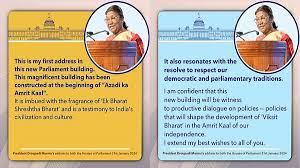
Confident new Parliament building will have productive dialogues, says President Murmu
“We anticipate the Interim Budget 2024 to align with the government’s mission of uplifting the underprivileged and urge the government to introduce beneficiary schemes, especially as the General Sabha election approaches, focusing on the socio-economic empowerment of the marginalised.”“We hope for policies supporting our growth, particularly in Tier 2, 3, and 4 cities, aiming to integrate rural communities into the formal banking system.Incentivising FinTech dedicated to empowering SMEs through financial and technical interventions would mark a significant stride. Addressing loan disbursement including loans against gold/jewellery, we recommend regulations fostering collaboration between traditional banks and digital lenders for accessible loans,” Anuj Arora, Co-founder & COO, SahiBandhu Gold Loans said.“As we approach Budget 2024, we anticipate a continued focus on advancing India’s digital public infrastructure, a key pillar for realising the $5 trillion economy dream. I look forward to enhanced government initiatives fostering financial inclusion benefiting ‘Bharat’, not just India,” said Sarvjeet Virk, Co-founder & MD, Finvasia. “On the tech front, I hope to see further progress in establishing AI Centres of Excellence. I also expect more policies to enable public-private partnership to boost end-use-cases of generative and predictive AI and increase its adoption in India. The fintech industry, as usual, will be the flag bearer of innovation,” Virk added. “The landscape of online new car sales has experienced a substantial surge over the past 4-5 years, driven by an increasing preference for consumers buying cars digitally. We are expecting some key developments from the budget like a reduction in the GST rate that will support home-grown players in investing in newer technologies for enhanced mobility offerings on a global scale. Then, re-evaluation of the import structure for electric vehicles is also sought to address disparities in GST rates, providing a much-needed boost to the start-up community through government loans and investments. As an online new car market player, we are closely monitoring these developments, recognizing their potential impact on the electric vehicle market. Our commitment is to adapt our platform to the evolving landscape, ensuring that our customers have access to the latest and most sustainable automobile options. We look forward to the Union Budget introducing measures that not only support the growth of the electric vehicle industry but also contribute to a more sustainable and eco-friendly future,” Gaurav Aggarwal, CEO and Founder, CarLelo, A Capri Loans Venture said.
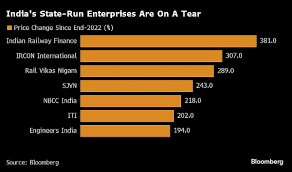
Stocks & sectors likely to benefit from 2024 Interim Budget
Companies building roads, ports and airports are on traders’ watchlist as Prime Minister Narendra Modi’s administration is set to present its last budget before the national elections. Shares linked to rural spending and state-owned firms are likely to be a focus area in Finance Minister Nirmala Sitharaman’s budget speech on Thursday, as policymakers seek ways to boost demand in the vast rural hinterland. Development of highways, tunnels and power plants is among the key focus areas for the government, which has more than doubled its capital spending over the last three years. Modi has made infrastructure building a cornerstone of his economic policy, helping India expand faster than any other major economy. The optimism seeped into the nation’s stock markets, which have advanced in all but one year since Modi first came to power in 2014. The enthusiasm has waned a bit this month, with foreign investors taking out more than $2.6 billion from local equities.The Feb. 1 budget is an interim one until a new administration takes office. It will still be keenly followed as the proposals would provide an indication on the government’s assessment of the economy, with Modi widely expected to win a third term in the elections due around April-May.

Before polls, stocks are expected to benefit from the governments interim budget.
As the government of Prime Minister Narendra Modi prepares to unveil its final budget before the national elections, traders are keeping a close eye on companies that are involved in road, port, and airport construction. In her budget speech on Thursday, Finance Minister Nirmala Sitharaman is expected to highlight shares associated with state-owned companies and rural spending, as policymakers look for ways to increase demand in the vast rural hinterland.Building infrastructure has become a key component of PM Modi's economic strategy, enabling India to grow faster than any other major economy. The nation's stock markets, which have increased in all but one year since PM Modi took office in 2014, began to show signs of optimism. This month, foreign investors withdrew more than $2.6 billion from local equities, indicating a slight decrease in enthusiasm. Spending on Infrastructure One of the government's main priorities is the construction of power plants, highways, and tunnels; during the past three years, capital spending has more than doubled.The main winners of this policy push have been the shares of industrial and capital goods companies, ranging from billionaire Gautam Adani's conglomerate to engineering behemoth Larsen & Toubro. Over the past year, BSE Ltd.'s sectoral gauges of capital goods and industrial firms have increased by over 70%, outpacing the benchmark index's 17% gain. Vinit Sambre, head of equities at DSP Mutual Fund, said over the phone, "A lot of the market performance has come from the capex cycle; equity investors would want to see that momentum continue." "Any guidance on the capex path will be closely watched."
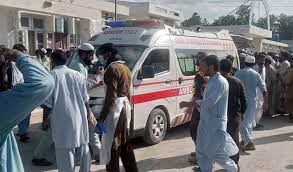
Four killed by bomb explosion near Pakistan political rally
At least four people were killed Tuesday in a bombing near a Pakistan political rally, officials said, as the nation prepares to go to the polls next week.Police in the Balochistan provincial capital of Quetta said a bomb planted on a motorbike detonated as supporters rallied for the Pakistan Tehreek-e-Insaf (PTI) party of jailed ex-prime minister Imran Khan."The PTI rally was passing by there but it is not clear whether the rally was a target or not," senior police official Farhan Zahid told AFP.The 71-year-old former cricket star was ousted from office in 2022 and launched a campaign of defiance against Pakistan's military kingmakers, who he said conspired to end his premiership.Last year saw casualties hit a six-year high, with more than 1,500 civilians, security forces and militants killed, according to the Islamabad-based Center for Research and Security Studies.Islamabad has blamed the rise in attacks on the Taliban, saying they are not doing enough to root out militancy in Afghanistan. Waseem Baig, a provincial health department spokesman, said six people were wounded in addition to the four killed.In a statement, PTI said three of its activists were among the dead at the rally -- a convoy of motorbikes and cars parading through the city to curry support for a candidate ahead of national elections scheduled for February 8.A party spokesman told AFP it was too soon to say whether they had been deliberately targeted.The attack came just hours after PTI founder Khan was sentenced to ten years in prison on charges of having leaked classified state documents.Khan and PTI say they are suffering under an unprecedented crackdown designed to prevent their return to power through the February 8 poll.Since then he has been buried under an avalanche of legal cases and barred from standing for office, whilst PTI has been largely squeezed out of the public sphere.Pakistan has also been suffering from a security crisis, with a dramatic uptick in militant attacks since the Taliban returned to power in neighbouring Afghanistan.


