


Top Trending Finance & Stock Market News & Highlights


Ether retreats after momentarily touching the $3,000 mark, while Bitcoin drops from the $52,000 mark.
On Wednesday, February 21, there was a tiny 0.31 percent gain for Bitcoin. At the moment, Bitcoin is worth $51,977, or about Rs. 43 lakh. Market analysts claim that the resistance level for Bitcoin is currently at $53,000, or approximately Rs. 43.9 lakh; a breach of this level would signal a significant increase in the value of the asset. The price of Bitcoin has seen a significant increase of $400 (approximately Rs. 33,160) in the last day. Wednesday's market volatility was reflected in the cryptocurrency chart, where altcoins fluctuated between gains and losses. For the first time since April 2022, Ether crossed the $3,000 (about Rs. 2.48 lakh) threshold. But at that point, the asset was unable to maintain a significant advantage. Ether's current value, after a 2.05 percent loss, is $2,870, or approximately Rs. 2.3 lakh. "Bitcoin is indicating overbought conditions in the current market environment, which is causing investor caution regarding possible consolidation. Ethereum, on the other hand, is showing an ascending channel pattern, driven by continuous developments in its ecosystem and flirting with $3,000 (about Rs. 2.48 lakh). Deviating from their customary daily routines, investors are being cautious because of a recent buying frenzy amid bullish momentum suggested by moving averages, according to Rajagopal Menon, Vice President of WazirX, who spoke with Gadgets360. Market observers are currently more interested in watching Ether's trajectory than Bitcoin's. "Ethereum has a huge following. For most Web3 developers, it is the default option when it comes to compute networks. This translates to increased traffic volume and road upkeep. Therefore, an update to make the highway much smoother is being shipped by developers. They are also doing it without causing any traffic hiccups. They port the upgrade to the mainnet highway after testing it on the testnets, or service road. Dencun's planned mainnet launch in March "can be seen as an internal catalyst for a better Web3 future," according to CoinSwitch co-founder Ashish Singhal.
Published 22 Feb 2024 02:33 AM

India Accepts All Foreign Investment In The Space Industry
In an effort to facilitate business in the nation, the Indian government approved an amendment on Wednesday that permits 100% foreign direct investment (FDI) in the space sector. The government stated in a statement that the FDI policy reform will encourage growth in investment, income, and employment. The government stated in a statement that the FDI policy reform will encourage growth in investment, income, and employment.
Published 22 Feb 2024 01:45 AM

The Price of Bitcoin Exceeds $48,000
At the time of publishing, the price of the most popular cryptocurrency in the world, Bitcoin, was $48,101 (approximately Rs. 39.9 lakh), having seen a slight increase of 0.74 percent on Monday. The digital asset gained $1,826 in value over the course of the weekend (about Rs. 1.5 lakh). The next target, according to market analysts, would be $50,000 (about Rs. 41.5 lakh), which is a milestone that Bitcoin hasn't been able to reach since December 2021, if the price of the cryptocurrency rises above $48,970 (about Rs. 40 lakh). Ether's value fell by 0.55 percent on Monday as it was unable to keep up with Bitcoin's gains. At the moment, ether is worth $2,498 (about Rs. 2.07 lakh). Due to large net inflows into spot Bitcoin ETFs the week before, Bitcoin surged above $48,000 (about Rs. 39.8 lakh) over the weekend, hitting its highest level in 26 months. The CEO of Mudrex, Edul Patel, told Gadgets360 that Ethereum also reached its highest point since January 19 at $2,540, or roughly Rs. 2 lakh. It is currently consolidating around $2,500, or roughly Rs. 2.07 lakh, with resistance at $2,620, or roughly Rs. 2.17 lakh, and support at $2,440, or roughly Rs. 2.02 lakh.The majority of cryptocurrencies saw losses on Monday, including Ether. These comprise Avalanche, Dogecoin, Cardano, Ripple, and Binance Coin. On Monday, the values of other altcoins, including Uniswap, Shiba Inu, Litecoin, Bitcoin Cash, Solana, and Binance Coin, also decreased. In the past day, the value of the cryptocurrency industry as a whole fell by 0.76 percent. According to CoinMarketCap, the current value of the cryptocurrency market is $1.8 trillion, or approximately Rs. 1,49,40,576 crore. Ether's market share is currently 16.7%, while Bitcoin's dominance is currently 52.5 percent.This week, there will probably be a few notable token unlocks, such as the release of SAND from Sandbox worth over $96 million (about Rs. 796 crore), or roughly 9% of the total supply. We plan to do this on Valentine's Day. Additional unlocks include Aptos, which released more than 7% .
Published 13 Feb 2024 01:20 AM

Paytm Payments Bank Is Looking To Employ Outside Compliance
Four people with knowledge of the situation claim that Paytm Payments Bank Ltd. has sent out a request for proposals to outside auditors. According to the individuals cited above, who requested to remain anonymous, the bank only made this RFP available to outside auditors. As a result, it is not in the public domain.According to the three individuals mentioned above, the goal of this RFP is to audit the bank for compliance and the know-your-customer procedure.As stated by the first person quoted above, Paytm Payments Bank also hopes to demonstrate to the Reserve Bank of India that it is fully compliant by starting this audit. One97 Communications Ltd.'s associate company came under heavy fire from the RBI on January 31 for "persistent non-compliance" and serious "supervisory concerns." The regulator stated in its directives that Paytm Payments Bank will not be able to take new credit transactions, top-ups, or deposits into its accounts after February 29.
Published 10 Feb 2024 10:20 AM


Finance & Stock Market
Finance & Stock Market

For FY23, Unacademys revenue jumps 26% to Rs 907 crore while its loss cuts
The test-prep startup Unacademy reported that, despite constant layoffs at the company, its losses in FY23 decreased by 41% to Rs 1,678 crore. In FY23, employee-related expenses decreased by 28% to Rs 1,281 crore.The test-prep startup Unacademy reported that, despite constant layoffs at the company, its losses in FY23 decreased by 41% to Rs 1,678 crore. In FY23, employee-related expenses decreased by 28% to Rs 1,281 crore.In what was a difficult year for the startup environment, many modern businesses, like Myntra, ZestMoney, and Curefoods, reported stronger revenues for FY23, but their losses also increased.Revenue at Myntra rises to Rs 4,375 crore: The apparel retailer Myntra, which is owned by Flipkart, reported a 25% increase in operating revenue to Rs 4,375 crore in FY23, despite a 31% increase in losses to Rs 782 crore. The online fashion platform's largest expense, amounting to Rs 1,758 crore, was spent on advertising and promotional activities, representing a 35% increase over the previous year.Unacademy reduces losses to Rs 1,678 crore, or 41%: Unacademy, a startup providing test preparation, reported that its losses in FY23, which included several layoffs at the company, decreased by 41% to Rs 1,678 crore. The Bengaluru-based firm saw a 26% increase in sales to Rs 907 crore during the year, while costs associated with payroll decreased by 28% to Rs 1,281 crore.ZestMoney reports a loss of Rs 412 crore. ZestMoney, a troubled startup that has been searching for a buyer, declared a net loss of Rs 412.4 crore for the fiscal year 2023. On the other hand, while total expenses increased by 21% to Rs 662.2 crore, overall revenue for the buy-now-pay-later platform increased by 72% to Rs 250 crore.

SentinelOne, a US-based company, purchases PingSafe, a Bengaluru cybersecurity startup.
SentinelOne, an AI-powered cybersecurity startup based in the United States, said on Wednesday that it has reached an agreement to purchase Bengaluru-based PingSafe for an undisclosed sum.The Mountain View, California-based business said in a statement that it will buy PingSafe for a mix of cash and stock, and that the deal is anticipated to close in SentinelOne's first quarter of the 2025 fiscal year, contingent upon customary closing conditions and any necessary regulatory approvals.The Mountain View, California-based business said in a statement that it will buy PingSafe for a mix of cash and stock, and that the deal is anticipated to close in SentinelOne's first quarter of the 2025 fiscal year, contingent upon customary closing conditions and any necessary regulatory approvals.Bengaluru: The $100 million purchase of Bengaluru-based cloud security platform PingSafe by NYSE-listed SentinelOne is hailed as the greatest acquisition in the history of Indian cyber security startups. According to Barclays' report, the transaction is made up of both cash and stock.Companies won't have to deal with the complexity of multiple-point solutions, triage and analyze cases with insufficient context, or stream data between different data silos thanks to this new approach to cloud security. Rather, companies can manage their whole attack surface from a single platform that offers all the analytics, real-time interaction, and full context required to correlate, detect, and thwart multi-stage attacks in a straightforward manner—unlike old CNAPP and standalone solutions.

Following board approval, Fino Payments Bank requests an SFB licence from the RBI.
The Reserve Bank of India has received an application for a small finance bank (SFB) license from Fino Payments Bank, a division of Fino Paytech Limited (RBI). The RBI announced in a statement on Monday, January 8, that Fino Payments Bank had submitted an application in accordance with the SFBs' "Guidelines for on-tap licensing."The bank's board gave its approval in July 2023 to the application for an SFB license and instructed the creation of a committee to move forward with the evaluation of a reverse merger with Fino Paytech Limited, the bank's parent company. "Our SFB will be a Payments Bank++ model, different from existing players," stated Chief Financial Officer Ketan Merchant at the time. "In the first few years of operation, fee-based income will constitute 75% – 80% of the revenue."Fino's net worth is estimated to be over INR 600 Cr, but small financing banks currently need INR 200 Cr to meet their minimal capital requirements. On June 30, 2017, Fino Payments Bank commenced its business activities. Among its notable investors are Bharat Petroleum, ICICI Group, Blackstone, IFC, Intel, and LIC.
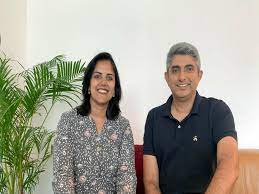
Fireside Ventures leads a 50 crore Series A fundraising round for mental health firm Amaha.
On Wednesday, Amaha, a company focused on mental health, announced that it has raised ₹50 crore in a Series A financing round led by Fireside Ventures. ₹15.6 crore more was contributed by other angel investors.Amaha, the former InnerHour, intends to expand and improve its mental health offerings with the help of this investment. Serving more than 600 Indian locations, the Mumbai-based organization provides a range of therapies and care programs for mental health issues like anxiety, depression, bipolar disorder, ADHD, OCD, schizophrenia, and addictions.The portfolio of Fireside Ventures, an investment firm that focuses mostly on consumer-focused startups, comprises businesses in the food and beverage, personal care, kids & education, lifestyle, and home products industries. It made investments in various wellness firms last year, including The Good Bug and Inito.A portion of the increased awareness and support for mental health and wellness in recent years has come from celebrities, including actors and cricket players, as well as from a number of organizations and social media platforms. Amaha was established in 2016 and offers digital services via an app that provides self-care tools and resources, in addition to operating physical centers in Delhi NCR, Bengaluru, and Mumbai. The founder and CEO of Amaha, Amit Malik, stated in an interview with Mint that "we're looking to go beyond digital at this stage because I think there is a lot of unmet need within the industry." Amaha has been aggressively investing in infrastructure, including physical clinics and technical advancements, despite growing losses in 2023 and maintaining a positiveAmaha obtained $5.2 million from Lightbox Ventures, a venture capital firm, in 2021. Additional angel investors that took part were Hitesh Oberoi, CEO & MD of Info Edge India Pvt. Ltd., Pankaj Sahni, CEO of Medanta-The Medicity Hospitals, and Capricorn Ventures & Micasa Investments (Singapore).

ETtech Deals Digest: This week, startup funding dropped 70% to $102 million.
In the second week of 2024, investments in startups fell by around 70% year over year to a total of $102.1 million across 26 different agreements, indicating that the funding crunch was not going away. According to data from Tracxn, companies in seed, early, and late stages raised around $288 million between January 6 and January 12, 2023.At roughly $49 million, or 48% of the total deal value, the early stage saw the largest amount of capital raised throughout the week. $35.2 million in late-stage finance, representing 35% of the total, came next.Funding increased sequentially in the most recent week, rising more than three times in volume and nearly three times in value terms. These cutting-edge businesses closed eight deals for $35.8 million last week.The latest numbers come after a busy spell of dealmaking in December, which came as a twist at the end of 2023 – one of the weakest years for venture capital activity in the country.The financial shortage persisted as evidenced by the fact that, in the second week of 2024, investments in startups plummeted by over 70% year over year to a total of $102.1 million across 26 separate agreements. Tracxn data indicates that between January 6 and January 12, 2023, companies in seed, early, and late stages raised approximately $288 million.In the second week of 2024, investments in startups fell by around 70% year over year to a total of $102.1 million across 26 different agreements, indicating that the funding crunch was not going away. According to data from Tracxn, companies in seed, early, and late stages raised over $288 million between January 6 and January 12, 2023.

Rupee ends lower under pressure from the stronger dollar and probable equity outflows.
Pressured by anticipated equity outflows and the U.S. dollar index rising to a more than one-month high due to moderating expectations for U.S. rate cuts, the Indian rupee ended lower on Wednesday.The rupee closed at 83.1375 against the dollar, down 0.08% from the previous session's close of 83.07.In Asia hours, the dollar index reached its highest point since mid-December, 103.58. With a decline of 0.91%, the Korean won led all Asian currencies in decline.Federal Reserve Governor Christopher Waller on Tuesday said that while the U.S. is “within striking distance” of the Fed’s 2% inflation goal, the central bank should not rush to cut benchmark interest rates.The comments prompted investors to pare bets on aggressive rate cuts.”A combination of weakish China data and a pushback” by European Central Bank and Fed officials against early easing is weighing on risk sentiment and supporting the dollar, ING Bank said in a note. In the meantime, data released on Wednesday indicates that China's economy grew marginally slower in the October–December quarter than anticipated. According to a foreign exchange trader at a private bank, pressure on the rupee on Wednesday came from dollar bids from foreign banks, probably acting on behalf of custodian clients.The blue-chip NSE Nifty 50 shed 2.09%, while the S&P BSE Sensex lost 2.23%. This is the highest percentage drop for both the indexes since June 2022.The rupee’s weakness is unlikely to “sustain a lot as the tilt or bias on the rupee remains positive”, Arnob Biswas, head of foreign exchange research at SMC Global Securities, said.Investors now await December U.S. retail sales data due later in the day, which is expected to show a month-on-month rise of 0.4%, up

Evolving Trends in Stock Market Regulations: Adapting to Algorithmic and Automated Trading in India
With the growing use of automated and algorithmic trading, the Indian stock market is going through a major transition. This technological evolution demands a corresponding shift in regulatory frameworks to maintain market integrity, fairness, and stability. High-frequency trading (HFT) and other forms of algorithmic trading have grown significantly in the Indian market. In order to profit from transient market movements, HFT, in particular, employs techniques like market making, momentum trading, and statistical arbitrage. While these technologies enhance market efficiency and liquidity, they also pose challenges such as potential market manipulation and a possible unfair advantage to large institutions over smaller investors. The Securities and Exchange Board of India (SEBI) has taken the initiative to regulate algorithmic trading in response to these issues. The main goal of the most recent regulations is to guarantee that exchanges have approved and certified all trading algorithms. This includes a thorough vetting process, and brokers are required to ensure proper security measures are in place to prevent unauthorized algorithmic activities. Additionally, SEBI has tightened short-selling norms to prevent market abuses like naked short-selling, mandating that all investors honor their securities delivery obligations. The Indian stock market is undergoing a significant transformation as a result of the uptake of cutting-edge trading technologies like algorithmic and high-frequency trading. A commitment to ensuring a dynamic, equitable, and resilient financial ecosystem is reflected in SEBI's evolving regulations. As these technologies continue to advance, the collaboration between regulators and market participants will be key to maintaining the integrity and efficiency of the Indian financial markets.

Offer for New Fund: Motilal Oswal The Motilal Oswal Large Cap Fund is launched by AMC; should you invest?
The "Motilal Oswal Large Cap Fund" is the newest investment product offered by Motilal Oswal Asset Management Company. The AMC claims that this open-ended equity scheme is purposefully created to give investors a special chance to capitalize on the large-cap segment's potential.Investment Objective: To achieve long-term capital appreciation by predominantly investing in equity and equity-related instruments of large-cap companies. Nevertheless, there can be no guarantee that the scheme's investment goal will be accomplished.

The U.S. economy will be impacted in 2024 and 2025 by "all these very powerful forces," according to Jamie Dimon.
Jamie Dimon, the CEO of JPMorgan Chase, stated that he is still cautious about the U.S. economy for the next two years due to a mix of geopolitical and financial risks. At the World Economic Forum in Davos, Switzerland, on Wednesday, Dimon told Andrew Ross Sorkin on CNBC, "You have all these very powerful forces that are going to be affecting us in '24 and '25.""I still wonder if we fully comprehend the mechanisms behind the quantitative tightening, the terrorist activity in Israel and the Red Sea, and the Ukraine," Dimon stated. The term "quantitative tightening" describes actions taken by the Federal Reserve to lower the size of its balance sheet and scale back earlier initiatives, such as bond-purchasing plans. Despite record profits at JPMorgan, the country's largest bank, and an unexpectedly strong U.S. economy, Dimon has urged caution over the past few years. Because of high employment rates and savings from the pandemic, the American consumer has largely remained healthy despite the damaging effects of inflation.n Dimon’s view, the relatively buoyant stock market of recent months has lulled investors on the potential risks ahead. The S&P 500 market index rose 19% in the past year and isn’t far from peak levels. “I think it’s a mistake to assume that everything’s hunky-dory,” Dimon said. “When stock markets are up, it’s kind of like this little drug we all feel like it’s just great. But remember, we’ve had so much fiscal monetary stimulation, so I’m a little more on the cautious side.



HeroMotoCorp unveils CE001 Limited Edition: A tribute to founder on 100th birth anniversary
HeroMotoCorp, the renowned two-wheeler giant, stole the spotlight at the Hero World 2024 event with the dazzling showcase of the Mavrick and Xtreme 125R. However, the real showstopper turned out to be the unexpected unveiling of the highly anticipated CE001 limited edition motorcycle. This exclusive model, based on the new Hero Karizma XMR 210, is set to capture the hearts of motorcycle enthusiasts, as it pays homage to Hero Group's founder, Dr. Brijmohan Lall Munjal, on his 100th birth anniversary.Marking a significant milestone, the Hero CE001 represents the company's first foray into crafting limited edition offerings for its customers. Described by the manufacturer as the "most special bike built in India," this commemorative edition is a testament to the legacy of Dr. Brijmohan Lall Munjal and the rich history of the Hero Group. The choice of the Hero Karizma XMR 210 as the base for the CE001 holds sentimental value, as the original Karizma was conceived during the tenure of Dr. Brijmohan Lall Munjal as the Chairman Emeritus. The CE001 maintains the essence of the original design, incorporating the distinctive half-fairing version that pays homage to the classic motorcycle. Adding to its allure, the limited edition motorcycle features bodywork crafted from lightweight carbon fiber, ensuring a substantial reduction in weight compared to the stock model. Riders can also expect an upright riding posture for enhanced comfort. While HeroMotoCorp has not disclosed specific details about engine modifications, it is anticipated that the CE001 will boast a power boost over the standard model. The Hero Karizma XMR, serving as the foundation, boasts a trellis frame housing a potent 210 cc single-cylinder, liquid-cooled engine, producing 25 bhp and 20 Nm of peak torque. The CE001 is expected to offer a superior power-to-weight ratio, accompanied by a range of performance upgrades, including the inclusion of an Akrapovic exhaust. The company has committed to delivering all 100 units of the CE001 by July this year, with the entire stock available for purchase online. New Delhi: The upcoming interim budget is unlikely to have any additional incentives for hybrid vehicles, people aware of discussions in the government said. A scheme, FAME-II, already exists to incentivize both hybrid and electric vehicles. In addition, a committee instituted by the ministry of heavy industries (MHI) will seek the Indian auto industry’s views on the possibility of reducing taxes on hybrid vehicles. According to documents released by the U.S. National Highway Traffic Safety Administration, Tesla acknowledges that software instability may impede the display of images from the backup camera while the vehicle is in reverse, thereby heightening the risk of a potential collision. Tesla emphasizes in the documents that it is currently unaware of any reported crashes or injuries related to this issue. The problem has reportedly been rectified through an online software update.Owners of the affected vehicles will receive notification letters starting March 22.
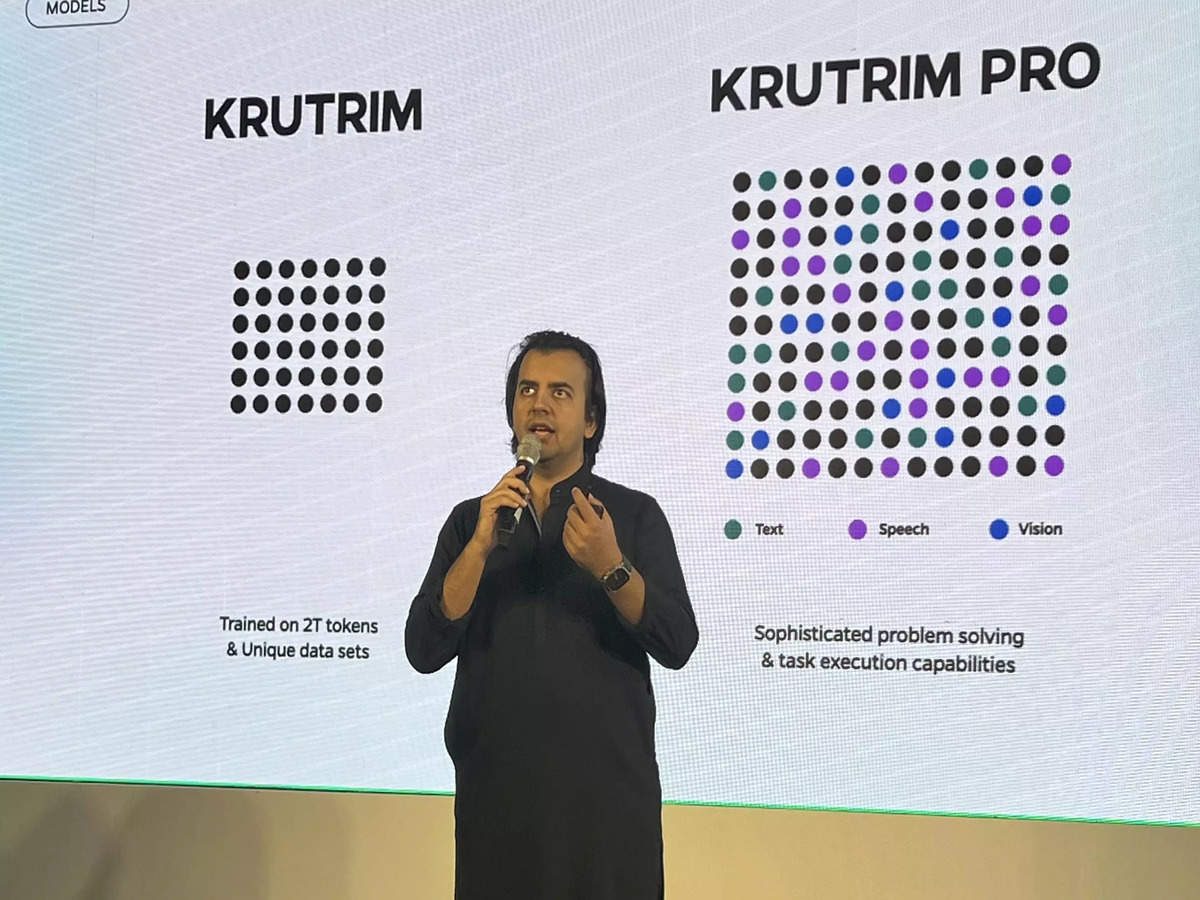
Ola founder’s Krutrim turns unicorn after raising $50 mn
BENGALURU: Ola founder Bhavish Aggarwal’s AI start-up Krutrim has turned unicorn after raising $50 million in equity. The round was led by investors including Matrix Partners India and others. Krutrim also becomes the country’s first AI start-up to attain a unicorn status. The funds raised will be instrumental in accelerating the company’s mission to revolutionise the AI landscape, drive innovation, and expand its reach globally, the start-up said. Bhavish Aggarwal, founder of Krutrim said, “India has to build its own AI, and at Krutrim, we are fully committed towards building the country’s first complete AI computing stack.” “We are thrilled to announce the successful closure of our first funding round, which not only validates the potential of Krutrim’s innovative AI solutions but also underscores the confidence investors have in our ability to drive meaningful change out of India for the world.” Last month, Krutrim unveiled its base Large Language Model (LLM). With the largest representation of Indian data used for its training, it powers generative AI applications for all Indian languages. Trained by a team of leading computer scientists, based in Bengaluru and San Francisco, this model will power Krutrim’s conversational AI assistant that understands and speaks multiple Indian languages fluently, it said. Krutrim is a family of Large Language Models, including Krutrim base and Pro that will have multimodal, larger knowledge capabilities, and many other technical advancements for inference. Trained on over 2 trillion tokens, Krutrim accomplishes better performance on multiple well known, global, LLM evaluation benchmarks including MMLU, HellaSwag, BBH, PIQA and ARC, the start-up said. Krutrim will be available in beta version for consumers in February 2024. Additionally, it will also be available as an API for enterprises and developers, seeking to create AI applications. The company is working on AI infra to develop indigenous data centers and eventually, server-computing, edge-computing and super-computers.
Yes Bank Q3 Results: Net profit soars 349.7% to Rs 231.6 crore; asset quality stable
Yes Bank Ltd's fiscal third-quarter profit surged more than fourfold but fell short of analysts' estimates. Net profit rose to Rs 231.6 crore for the quarter ended December 31 from Rs 51.5 crore a year ago, the bank said in a statement to stock exchanges on January 27. That compares with the Rs 415.1 crore quarterly profit estimate of brokerage Emkay Global.The lender's gross non-performing assets (NPA) remained steady at 2 percent in the three months ended December 31, while net NPA improved to 0.9 percent. Net interest income (NII) increased 2.3 percent from a year earlier. Operating profit rose 5.4 percent to Rs 864 crore.The bank also reported a 13.2 percent growth in deposits to Rs 2.4 lakh crore from last year. The current and savings account ratio (CASA) saw a slight decline to 29.4 percent in the quarter ended December 31 from 29.7 percent in the year earlier.

Bajaj Finance Q3 Preview: NII to rise 26%, net profit to jump 25% on strong AUM growth
All eyes will be on Bajaj Finance on January 29 as the non-banking financial company (NBFC) will declare its December quarter results. As per a poll of six brokerages, the lender's consolidated net profit is expected to rise 25 percent year-on-year to Rs 3,716 crore. An average of four brokerages shows that net interest income is expected to rise 26 percent YoY to Rs 9,344 crore. Stable asset quality and strong AUM (assets under management) growth will drive earnings, as per analysts. Bajaj Finance, on January 3, declared provisional numbers for the December quarter AUM. On the back of a strong festive season, the company's AUM crossed the Rs 3-lakh-crore mark for the first time in the quarter gone by, surging 35 percent YoY. As per the Q3 update, its deposit book grew by 35 percent to Rs 58,000 crore. During the quarter, it booked 98.6 lakh new loans, a YoY growth of 26 percent.According to domestic broking firm Motilal Oswal Financial Services margins and spreads are likely to decline sequentially by ~25 basis points and 15 basis points, respectively. Credit costs are expected to rise ~10 basis QoQ to ~1.7 percent. Axis Securities also sees margins declining by ~10-15 basis points QoQ owing to an inch-up in cost of funds. Inching up of the cost of funds is an industry-wide trend, noted Jefferies, due to the lagged repricing of MCLR-linked loans. In November 2023, the Reserve Bank of India asked Bajaj Finance to stop issuing new loans through its “eCOM” and “Insta EMI Card” for non-compliance with digital lending guidelines. It is important to watch out for management commentary on the same. Bajaj Finance Q3 results also come after RBI's caution against unsecured lending and risk-weightage increase for consumer credit. While analysts are confident of Bajaj Finance's liquidity position on the back of Rs 10,000 crore fundraising, it will be crucial to monitor management commentary on how Bajaj Finance's borrowing mix will change going ahead as banks' lending to NBFCs slows down. Apart from that, the Street will also be monitoring how new products are scaling up and if any segments are showing signs of stress.

Day 2 Box Office Collection for Fighter: Deepika Padukone and Hrithik Roshans eyes The ₹100 crore club
Day 2 of Fighter Box Office Collection: The film, starring Hrithik Roshan and Deepika Padukone, was released on January 25, one day ahead of Republic Day. During the second day of the national holiday, the movie gained momentum and earned over 1.5 times its opening day total.During its two-day run in theaters across all languages, "Fighter" brought in a net collection of ₹61.5 crore in India, according to film industry tracker Sacnilk. On Republic Day, the movie earned ₹39 crore in net revenue. On the day of its release, it brought in ₹22.5 crore in India across all languages.Fighter Box Office Collection Day 2: During its two days in theaters, the movie "Fighter" has made a net collection of ₹61.5 crore in India. On Friday, its Hindi version had an overall occupancy rate of 41.57%.After making a reasonable (albeit not very impressive) Rs 24 crore on the first day, the big-budget Hrithik Roshan flick Fighter truly took off on the second day. Due to favorable buzz about the film's airborne action sequences, Fighter's profits on its second day of release—which fell on Republic Day holiday—are predicted to have soared by more than 70%. This raises the domestic two-day total of the film to Rs 61 crore. The anticipated amount for the domestic launch weekend is between Rs 120 crore and Rs 150 crore.Siddharth Anand's patriotic action film Fighter follows the lives of a few Air Force fighter pilots during a conflict. Supporting roles go to Karan Singh Grover and Akshay Oberoi in addition to Deepika Padukone and Anil Kapoor. According to Sacnilk, Fighter reported occupancy rates of 41% for the 2D standard version and 42% for the 3D edition. For both of the film versions, evening performances drew the majority of viewers. Chennai recorded occupancy of over 80% of its capacity, but Mumbai and the Delhi NCR area reported occupancy of roughly 50%. Fighter is not being marketed as a pan-Indian film, despite current trends. The first-day box office receipts for the film did not quite match the high expectations that Hrithik has set for himself recently (his two previous films with Siddharth Anand had larger debuts); nonetheless, they did signify a return to form for the actor, who was thought to have underperformed in his last film, Vikram Vedha. Fighter will beat the roughly Rs 80 crore that Vikram Vedha completed its domestic run with on day three alone.War remains Hrithik Roshan's highest-grossing movie to date, taking in over Rs 470 crore worldwide after earning Rs 53 crore the previous year. After its premiere at Rs 27 crore, Bang Bang made over Rs 350 crore globally. Siddharth, Deepika, and Anil Kapoor recently wrapped their successful film projects. The most recent film in which Anil appeared was the controversial hit Animal, whereas Siddharth and Deepika worked together in the Shah Rukh Khan movie Pathaan.

By2029, the media, advertising, and entertainment vertical will represent a $17.9 billion opportunity.
ResearchAndMarkets.com now offers the "Generative AI Market by Technology, Component, Application, Industry Vertical, and Region 2024-2029" report.The expected effects of the generative AI industry are evaluated in this research across multiple domains, such as ChatGPT in software, general-purpose platforms, IoT systems, and embedded consumer products. In addition to discussing the potential applications and use cases in several business verticals, the research also examines the underlying relationship between generative AI and AGI, ASI, and strong AI, as well as the influence of enabling technologies like 5G, business 4.0, MEC, self-driven networks, and others.A few of the report's findings: Through 2029, North America will dominate the worldwide generative AI market. Through 2029, the top industry vertical for generative AI will be healthcare. Through 2029, API-enabled solutions will have the fastest rate of growth (CAGR of 47%). By 2029, generative AI services will have grown to a $2.5 billion market at a 43.9% CAGR. By 2029, the media, advertising, and entertainment sector will represent a $17.9 billion potential.Artificial intelligence that can create unique and novel data or content, including literature, music, or graphics, is known as generative AI. Generative AI use algorithms to produce new data that did not previously exist, in contrast to other forms of AI that are intended to identify and categorize existing data. In order to accomplish this, the data is analyzed for patterns and relationships, and new content is created in response to those patterns.New models and architectures are being developed to enhance the diversity and quality of generated content as a result of the rapid advancement of technology. The use of technologies like GANs, transformers, and VAEs made it possible to create generative models that are more intricate and lifelike. To guarantee the moral and equitable use of technology, there were still issues to be resolved in areas like bias and data privacy.The growing requirement for automation and the expanding use of generative AI across a range of industries are driving the industry. Large datasets and the development of deep learning algorithms have also contributed to the market's expansion.
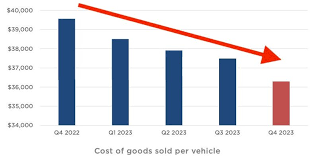
This chart shows how Tesla can keep cutting prices and stay ahead of the competition
Tesla keeps lowering the price of its cars.It's taken a margin hit, but its input costs are going down too.Tesla's price war sent shock waves through the industry, and the fallout is far from over.Still, Elon Musk's electric automaker is lapping the competition as old-guard automakers like Ford and General Motors switch to electric vehicles.That's in large part thanks to tremendous cost savings found in manufacturing.The average cost of building a Tesla in the fourth quarter fell once again, according to the company's earnings report released Wednesday. On average, Tesla spent just over $36,000 per vehicle it sold in the October to December period, down from over $37,000 per vehicle in the same quarter in 2023.At the same time, Tesla has been selling its vehicles for cheaper, showing Tesla's might over its competitors when it comes to EV pricing.Tesla has always had a lot of room to run on pricing, given its industry-leading profit margins. But Elon Musk's strategy to slash prices has chipped away at its once-40% gross margins, bringing them down to 17.6% in the fourth quarter.Still, that's far above the industry average of around 9%.While Tesla continues to play with prices, other automotive CEOs have warned against the practice. Stellantis CEO Carlos Tavares said last week he was keen to stay out of any EV price wars, but stopped short of mentioning Tesla by name. "If you go and cut pricing disregarding the reality of your costs, you will have a bloodbath. I am trying to avoid a race to the bottom," he said.Last year, Ford CEO Jim Farley compared Musk's strategy to that of Henry Ford."I think what he's going to learn is product freshness means a lot," Farley said of Musk at the time. "The product gets commoditized and then you lose your pricing premium. That's a really dangerous thing."
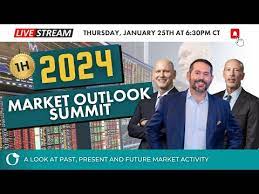
Market Outlook for 25 January 2024
Our markets witnessed high volatility ahead of the F&O expiry day. Nifty sneaked below 21200 mark during the day, but it recovered sharply towards the end and closed above 21450 with gains of about a percent from previous day’s close. Nifty Today: Nifty has corrected sharply in last few days from the high of 22124 to sub-21200 levels. The volatility has increased recently and when the range is broad, the 40-day EMA becomes an important level for the short term. This average support is placed around 21200 and the Nifty index has managed to recover and close well above this support in Wednesday’s session. Although the daily RSI remains negative, the readings on the hourly charts have given a positive crossover from the oversold zone and hence, we could see a pullback move in next few sessions. Thus, although the intraday volatility could remain high, the index can see some pullback towards 21600-21700 zone while 21300-21200 would be seen as immediate support. Traders are advised to trade with a stock specific approach for a while.
Indian Railway Finance Corporation share price Today Live Updates
Indian Railway Finance Corporation Share Price Today : The last day of trading for Indian Railway Finance Corporation saw an open price of ₹164.18 and a close price of ₹161.48. The stock had a high of ₹173.14 and a low of ₹150.81. The market capitalization for the company is ₹224,595.34 crore. The 52-week high for the stock is ₹160.89, while the 52-week low is ₹25.45. The BSE volume for the day was 30,763,279 shares.Disclaimer: This is an AI-generated live blog and has not been edited by LiveMint staff.Indian Railway Finance Corporation share price NSE Live :Indian Railway Finance Corporation trading at ₹174.21, up 1.37% from yesterday's ₹171.86. The stock price of Indian Railway Finance Corporation (IRFC) is currently ₹174.21, with a percent change of 1.37 and a net change of 2.35. This indicates that the stock has seen a slight increase in value. However, without further information, it is difficult to determine the overall trend or significance of this change.

Share Market Highlights: Sensex, Nifty close around 1% up; Broader markets, sectoral indices rallied
Sensex Today | Share Market Highlights: After a bout of choppy trading, both the benchmark indices consolidated in the green after opening in the red. Although they had dipped in the negative zone a few times through the day.Stocks gained as investors rewarded companies for positive earnings updates and as China’s latest move to stimulate its economy boosted resources shares.Europe’s Stoxx 600 index climbed 0.8% as mining stocks jumped the most in almost six weeks after the People’s Bank of China said it would cut the reserve requirement ratio for banks on Feb. 5. The move should boost the economy by freeing up liquidity for customer loans and bond purchases. US equity futures gained, led by tech stocks, after Wall Street set fresh closing highs on Tuesday. Asian stocks advanced, with Chinese shares traded in Hong Kong extending their rally after the stimulus news. Japanese government bond yields and bank stocks jumped Wednesday as investors decided that monetary policymakers are on track to scrap negative interest rates in the near term after all.As traders increased bets that the Bank of Japan will push ahead in the next few months with its first rate hike since 2007, 10-year note yields climbed as much as 10.5 basis points. Shares of Japanese banks, who have struggled through decades of deflation, rose on expectations higher interest rates will improve their lending margins.Elsewhere, the timing and extent of expected Federal Reserve rate cuts this year have dominated markets in recent weeks with less attention paid to Japan’s central bank. That left economists looking more bullish over the BOJ’s looming move than market players. After a day of choppy trading, both the benchmark indices ended in the green, around 1% above the previous day's close, after they had opened in the red.At close, Sensex was up 689.76 points, or 0.98%, at 71,060.31, Nifty was up 215.15 points, or 1.01%, at 21,453.95.Broader market indices also closed up 1%, whereas among sectoral indices, only the Nifty Private Bank ended the day in the red.Global shares rose on Wednesday, fuelled by positive tech earnings and optimism Chinese authorities will offer support to its stock markets, while the dollar showed resilience on growing expectations the U.S. Federal Reserve won't rush to cut rates.European stocks climbed 0.8%, with tech stocks adding over 3.6% to their highest in two years. Investors are also focused on manufacturing purchasing managers' index (PMI) figures - seen as a good gauge of economic health - from the euro zone, Germany, France and Britain later in the day.The European Central Bank (ECB) meets on Thursday and is widely expected to keep rates unchanged - though traders are pricing in as much as 130 basis points of interest rate cuts this year. Wall Street was set to gain, with e-mini futures for the S&P 500 up 0.4% as investors focused on a slew of earnings. The yield on 10-year U.S. Treasury notes was last at 4.097%, while the two-year Treasury yield, which typically moves in step with interest rate expectations, was at 4.314%.Markets are now pricing in a 47% chance of a rate cut in March from the Fed, according to the CME FedWatch tool, compared to the 88% chance of a rate cut priced in a month earlier.The MSCI world equity index, which tracks shares in 47 countries, gained 0.3%. The MSCI's broadest index of Asia-Pacific shares outside Japan gained 1%. Still, the index is down around 4.7% so far this month.After a bout of choppy trading, both the benchmark indices consolidated in the green after opening in the red. Although they dipped in the negative zone a few times through the day.At 3 pm, Sensex was up 683.54 points, or 0.97%, at 71,054.09, Nifty was up 211.30 points, or 0.99%, at 21,450.10.
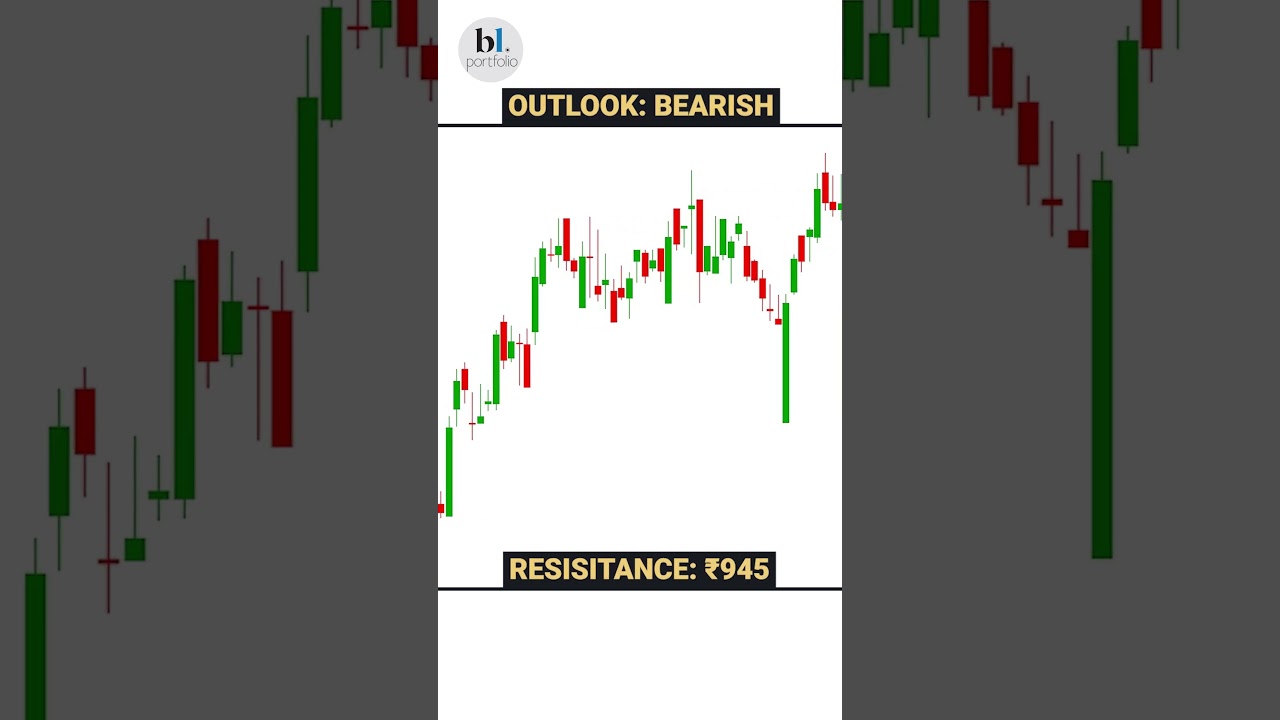
Share Market Highlights 24 January 2024:
Sensex, Nifty updates on 24 January 2024: India’s equity markets are volatile on Wednesday. The BSE Sensex rose 689.75 pts or 0.98% to close at 71,060.31. The NSE Nifty jumped 215.15 pts or 1.01% to close at 21,453.95. Analysts anticipated sustained selling pressure from foreign portfolio investors, emphasizing the significance of upcoming results and heightened volatility during the monthly F&O settlement. Siddhartha Khemka, Head of Retail Research at Motilal Oswal Financial Services, highlighted caution in global sentiments due to Fitch Group’s warning about the impact on South Asian economies and increased hostilities in the Red Sea. Technical analyst Pravesh Gour noted Nifty’s breakdown, signalling potential testing at 50-DMA at 21000, while Bank Nifty faces hurdles and support challenges. Market Update: Sensex surges 690 points to reclaim 71k leve Equity benchmark indices Sensex and Nifty rebounded sharply by one per cent on Wednesday after sliding for the past two sessions, propelled by bargain hunting in metal, commodity, and telecom stocks. Currency Market Live Updates: Rupee ends slightly higher, aided by yuan’s uptick, dollar’s slip. The rupee ended marginally higher on Wednesday, aided by a slight uptick in the offshore Chinese yuan and a pullback in the dollar index.The rupee ended at 83.1225 against the US dollar, compared with its close at 83.15 in the previous session.Bharat Dynamics reported its standalone net profit for the quarter ended December 2023 at ₹135.03 crore as against ₹83.74 crore in December 2022. The stock closed at ₹1,696.50 on the NSE, up by 1.61%.“The market rebounded from yesterday’s sell-off taking cues from global peers. The sentiment was reinforced by the PBOC’s 0.5% cut in reserve ratio to boost growth and financial liquidity. However, overall sentiment is muted as concerns persist on FIIs selling due to premium valuations in India and below expectation Q3 earnings so far.”

Zee-Sony Merger Called Off: These mutual funds have exposure to the stock
India's mutual fund houses have increased their stake in Zee Entertainment in all of the nine quarters since the Sony merger announcement in December 2021. As of the December quarter, the domestic mutual funds held a 32.49% stake in Zee Entertainment, which is more than double the 12.16% stake they held at the end of the December 2021 quarter when the deal was announced. The increase in stake also corresponds with the exit of its largest shareholder Invesco, which along with Oppenheimer, held close to 18% stake in Zee at the time of the merger announcement. While Invesco Developing Markets Fund exited the stock by selling its 7.8% stake in April 2022, the OFI Global China Fund earlier pared a 5% stake between October and December 2022, before making a complete exit in April 2023. Among the funds that own a substantial stake in Zee Entertainment as of the December quarter include ICICI Prudential Value Discovery Fund, Nippon India Multi-Cap Fund, and HDFC Mid-Cap Opportunities Fund, among others. Some of India's largest insurance companies, all listed, also own a stake in Zee Entertainment, including the country's largest insurer LIC, along with HDFC Life and SBI Life Insurance.


