

Top Trending Business News & Highlights


One accord, three setbacks India's use of the EU trade pact to boil Turkey, Pakistan, and Bangladesh
The United States has also been affected by India's trade agreement with the European Union. The historic trade deal between India and the EU would not only affect Bangladesh and Pakistan but also the United States and Turkey. The agreement calls for the elimination or reduction of tariffs on more than 90% of EU goods exports to India, including hefty charges of up to 44% on machinery, 22% on chemicals, and 11% on pharmaceuticals, which will be phased down over time.Following nearly two decades of negotiations, officials announced on Tuesday that India and the European Union have achieved a free trade agreement to strengthen economic and strategic ties. Up to 2 billion people might be impacted by the agreement, which the president of the EU's executive body referred to as the "mother of all deals." The accord won't go into force for some months. The agreement between two of the largest markets in the world comes as Washington imposes high import taxes on both the EU bloc and the Asian behemoth, upsetting long-standing trade patterns and forcing major economies to look for new alliances. The FTA, which both India and the 27-nation EU refer to as "the mother of all deals," provides a "decisive boost" to the labor-intensive textile industry by improving price competitiveness and expanding market access in one of the most sophisticated consumer markets in the world, according to a note released today by the Indian Textile Ministry.
Published 29 Jan 2026 12:51 PM
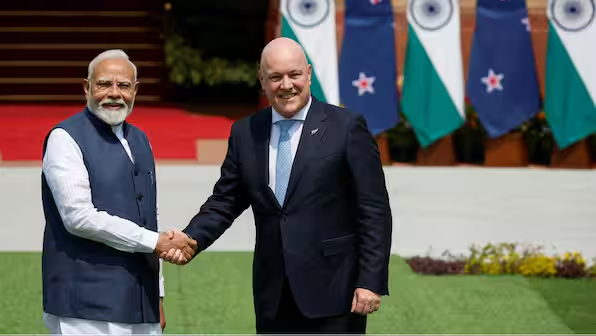
India and New Zealand wrap up free trade negotiations despite persistently high US tariffs
Free trade agreement (FTA) talks between India and New Zealand came to an end on Monday amid hefty US tariffs that have unsettled investors and led to the cancellation of orders from India's biggest export market. In the context of 50% US tariffs, the New Zealand agreement, if signed, would be India's second free trade agreement (FTA) following the Oman agreement. It would also be the country's third accord this year as it works to diversify its exports.According to information made public by the government, Wellington would remove tariffs on 100% of its tariff lines for all Indian exports, while India has committed to lower tariffs on 95% of New Zealand exports. However, New Zealand's typical tariffs are among the lowest in the world—between two and three percent—and their removal could not immediately boost exports. In order to bring some symmetry to the agreement, New Zealand has "committed" to investing $20 billion in India over the next fifteen years in exchange for market access in a rapidly expanding Indian consumer market that is subject to high tariffs (over 15%). Because of the unfair tariff rates, New Zealand may benefit more from goods trade than India.In 2024–2025, bilateral trade between India and New Zealand was only $1.3 billion. "This FTA opens doors for Indian businesses in the region through well-integrated directional exports and gives our youth choices to learn, work, and grow on a global stage," stated Commerce Minister Piyush Goyal."India's strengths are expanding exports, supporting labor-intensive growth, and power services," stated Commerce Secretary Rajesh Agrawal. New Zealand's access to India's sizable and expanding economy is deeper and more reliable. These qualities are brought together by the migration of individuals, professionals, students, and skilled workers. The FTA contains provisions to address non-tariff barriers through improved regulatory cooperation, transparency, and streamlined customs, sanitary and phyto-sanitary (SPS) measures, and technical barriers to trade disciplines, according to the Commerce and Industry Ministry, in addition to tariff liberalization. According to the Ministry, "all systemic facilitations and fast-track mechanisms for imports that serve as inputs for our manufactured exports ensure that tariff concessions translate into effective and meaningful market access."
Published 22 Dec 2025 10:28 PM

What workers, brokers, and policyholders stand to gain from travelers' agreement to preserve 1,400 jobs in Canada
The Canadian business of Travelers will be acquired by Definity Financial Corp. The total value of the acquisition is $3.3 billion. Definity will become the fourth-largest property and liability insurer in Canada as a result of this transaction. Every one of Travelers Canada's 1,400 employees will continue to work there. Consumers can anticipate competitive pricing and additional options. Regulatory permission is needed for the deal. By early 2026, it should be closed.Definity Financial Corp. plans to pay $3.3 billion to acquire the Canadian operations of the US behemoth Travelers, one of the largest transactions in Canada's insurance industry in recent memory. This merger could change the competitive environment for both insurers and consumers. More than 1,400 Traveler employees across Canada will retain their employment when the two companies combine under a single brand, despite the fact that large acquisitions frequently result in job losses.Definity will move up from sixth place to become Canada's fourth-largest property and liability insurer as a result of the purchase. Its expanding presence in the insurance industry is demonstrated by the $6 billion in total yearly premiums it currently manages.
Published 28 May 2025 07:58 PM

Why did India decide to remove the "Google tax" in response to pressure from the US?
The Center intends to eliminate the 6% equalization levy (EL) it levies on digital advertisements as part of the 35 modifications to the Finance Bill, 2025, effective April 1, 2025.The Central government has suggested to eliminate the equalization levy on internet advertisements as part of revisions to the Finance Bill, 2025, a move that is anticipated to help American large technology companies and allay US worries about India being a high tariff country.As part of changes to the Finance Bill, 2025, the central government has proposed doing away with the equalization levy on online ads. This is expected to benefit big IT companies in the US and ease concerns about India being a high-tariff nation.The equalization charge, also referred to as the Google tax, will be eliminated by the Center on April 1. The clause is one of 59 changes to the Finance Bill that Finance Minister Nirmala Sitharaman made on Monday and presented to Parliament.
Published 25 Mar 2025 08:42 PM


Business
Business globally are the pillars of any economy and they contribute in huge amount to take any country ahead financially and economically and boost the country grwoth.


VinFast, A Rival To Tesla, Is Likely To Construct An EV Battery Plant In India
The test-prep startup Unacademy reported that, despite constant layoffs at the company, its losses in FY23 decreased by 41% to Rs 1,678 crore. In FY23, employee-related expenses decreased by 28% to Rs 1,281 crore.The test-prep startup Unacademy reported that, despite constant layoffs at the company, its losses in FY23 decreased by 41% to Rs 1,678 crore. In FY23, employee-related expenses decreased by 28% to Rs 1,281 crore.In what was a difficult year for the startup environment, many modern businesses, like Myntra, ZestMoney, and Curefoods, reported stronger revenues for FY23, but their losses also increased.Revenue at Myntra rises to Rs 4,375 crore: The apparel retailer Myntra, which is owned by Flipkart, reported a 25% increase in operating revenue to Rs 4,375 crore in FY23, despite a 31% increase in losses to Rs 782 crore. The online fashion platform's largest expense, amounting to Rs 1,758 crore, was spent on advertising and promotional activities, representing a 35% increase over the previous year.Unacademy reduces losses to Rs 1,678 crore, or 41%: Unacademy, a startup providing test preparation, reported that its losses in FY23, which included several layoffs at the company, decreased by 41% to Rs 1,678 crore. The Bengaluru-based firm saw a 26% increase in sales to Rs 907 crore during the year, while costs associated with payroll decreased by 28% to Rs 1,281 crore.ZestMoney reports a loss of Rs 412 crore. ZestMoney, a troubled startup that has been searching for a buyer, declared a net loss of Rs 412.4 crore for the fiscal year 2023. On the other hand, while total expenses increased by 21% to Rs 662.2 crore, overall revenue for the buy-now-pay-later platform increased by 72% to Rs 250 crore.

For FY23, Unacademys revenue jumps 26% to Rs 907 crore while its loss cuts
The test-prep startup Unacademy reported that, despite constant layoffs at the company, its losses in FY23 decreased by 41% to Rs 1,678 crore. In FY23, employee-related expenses decreased by 28% to Rs 1,281 crore.The test-prep startup Unacademy reported that, despite constant layoffs at the company, its losses in FY23 decreased by 41% to Rs 1,678 crore. In FY23, employee-related expenses decreased by 28% to Rs 1,281 crore.In what was a difficult year for the startup environment, many modern businesses, like Myntra, ZestMoney, and Curefoods, reported stronger revenues for FY23, but their losses also increased.Revenue at Myntra rises to Rs 4,375 crore: The apparel retailer Myntra, which is owned by Flipkart, reported a 25% increase in operating revenue to Rs 4,375 crore in FY23, despite a 31% increase in losses to Rs 782 crore. The online fashion platform's largest expense, amounting to Rs 1,758 crore, was spent on advertising and promotional activities, representing a 35% increase over the previous year.Unacademy reduces losses to Rs 1,678 crore, or 41%: Unacademy, a startup providing test preparation, reported that its losses in FY23, which included several layoffs at the company, decreased by 41% to Rs 1,678 crore. The Bengaluru-based firm saw a 26% increase in sales to Rs 907 crore during the year, while costs associated with payroll decreased by 28% to Rs 1,281 crore.ZestMoney reports a loss of Rs 412 crore. ZestMoney, a troubled startup that has been searching for a buyer, declared a net loss of Rs 412.4 crore for the fiscal year 2023. On the other hand, while total expenses increased by 21% to Rs 662.2 crore, overall revenue for the buy-now-pay-later platform increased by 72% to Rs 250 crore.

Pre-Series A Funding of Rs 10 Crore is Secured by Settl for Co-Living Expansion
In a pre-series A investment round, investors including Gruhas, We Founder Circle, Inflection Point Ventures, and others have contributed Rs. 10 crore to the proptech startup Settl. Settl., which was founded in 2020, intends to use the money for technology advancement, staff growth, and working capital.With 60+ locations across Bengaluru, Hyderabad, Gurugram, and Chennai, Settl. is a co-living operator that offers 4000 beds, mostly for working people, for rental fees between Rs 12,500 and Rs 18,000 per bed.To date, the portal that lets users look for and rent completely furnished rooms, flats, or communal living spaces has raised a total of Rs 15 crore.Another IIT Madras initiative aims to support 100 businesses by 2024. By 2024, 100 companies from a variety of industries will be supported by the IIT Madras Incubation Cell (IITMIC), the institute's central hub for fostering, advising, and supervising diverse innovation and entrepreneurship initiatives."We at IIT Madras take tremendous satisfaction in the fact that we innovate a lot more. In 2024, we also want to launch 100 start-ups. A number of intriguing innovations are also emerging from IIT Madras-incubated start-ups, including Mindgrove Tech, AgniKul Cosmos, and Hyperloop start-up The ePlane Company. These startups will produce goods that are extremely important to the country." remarked Professor V. Kamakoti, Director of IIT Madras.

Weak rural demand is anticipated to have an influence on the volume growth of FMCG companies in Q3.
Leading FMCG companies anticipate sequential improvement in consumer demand and low to mid-single-digit volume growth in the October–December quarter. Leading listed FMCG companies including Dabur, Marico, and Godrej Consumer Products stated in their quarterly reports that consumer demand from the rural market is trailing, even while the urban markets remained stable in the third quarter as demonstrated in the September quarter.Businesses anticipate a slow recovery since there are encouraging trends in volume trends and early indications of a recovery in consumption.Additionally, the producers anticipate growth in gross margins year over year, which will be aided by a moderating effect on inflation as the costs of essential inputs, including copra and edible oil, continue to be lower, and there has been some downward bias in the prices of crude derivatives. This will assist FMCG companies in allocating more funding for marketing and promotions. "Increasing advertising and promotion (A&P) spending will be the primary driver of a sizable amount of the gross margin growth. As a result, operating profit is anticipated to increase year over year and record an improvement, according to Dabur India's quarterly updates. This is somewhat faster than revenue growth.